
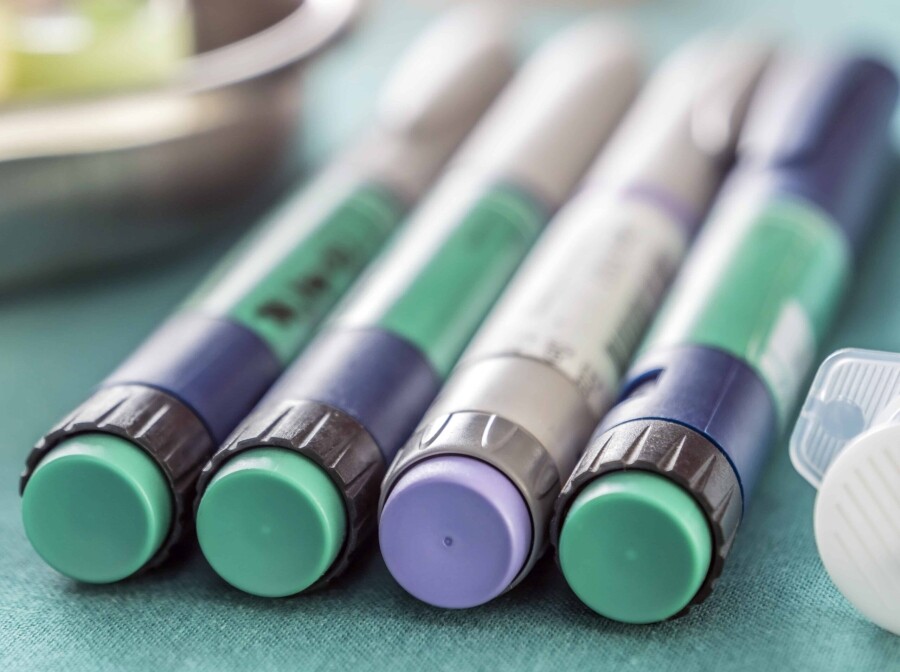
In this article, we’re going to provide lots of helpful information about Lantus SoloStar, including its cost, types, and more. But first, let’s give a quick answer to get you started.
What is Lantus SoloStar?
Lantus is the brand name for insulin glargine, a long-acting insulin with no peak hours. Lantus SoloStar is a prefilled pen that delivers this insulin, providing patients with a ready-to-use option for once-daily injections.
It treats type 1 and type 2 diabetes in adults, and type 1 diabetes in children ages 6 and older. Lantus SoloStar is FDA-approved, with a duration of action lasting up to 24 hours and steady insulin concentration throughout the day. It is also once-daily insulin with a steady concentration.
As much as it sounds convenient to use this insulin once a day, there’s much more to this long-acting insulin. Before getting into more details, let’s start with a few common questions that many people have about any long-acting insulin.

How Long Does Lantus Last?
After the injection of insulin, microprecipitates are formed in the subcutaneous tissue. This process tends to slow down the absorption of Lantus and thereby provides a relatively constant level of insulin for over 24 hours without a pronounced peak.

This performance that lasts for nearly 24 hours is what supports this insulin being administered or taken once daily. Also, to mention generally, any long-acting insulin will not have peak hours because they provide steady concentration for a longer period.
However, for some patients, it doesn’t last the whole 24 hours. In such a situation, patients are often recommended to take the insulin during the day. The insulin will reduce performance during the night, when the insulin requirements are naturally lower.
In some cases, patients use another supportive short-acting dosing if the Lantus SoloStar doesn’t last for long for them. But make sure that these are done after proper consultation with your healthcare provider.
How long Lantus lasts can vary from patient to patient, depending on individual body chemistry and any other health conditions present alongside diabetes. Talk to your doctor if you notice the insulin isn’t lasting as expected.
How Many Units Are in A Lantus SoloStar Pen?
Each Lantus SoloStar pen contains 3ml of solution for injection, which is equivalent to about 300 units. It will contain a clear and colorless solution. The pens can come in packs of 1, 2, 5, and even 10.
How Much Is a Lantus SoloStar pen Without Insurance?
Sanofi cut the list price of Lantus by 78% starting January 1, 2024, and now caps out-of-pocket costs at $35 per month for eligible patients, whether insured or uninsured. Eligible patients use the Sanofi Insulins Valyou Savings Program to reach that price without insurance, or the Lantus SoloStar Copay Program if commercially insured.
How Much Does a Lantus Insulin Pen Cost?
As mentioned, Sanofi now caps out-of-pocket costs at $35 per month for eligible patients, whether insured or uninsured.
| Payment Option | Single Pen (3 mL) | Carton of 5 Pens (15 mL) | 10 mL Vial |
| Cash price, no insurance | $63–$80 | $100–$550 | $70–$102 |
| Sanofi Insulins Copay Savings Program (commercially insured) | $35/month | $35/month | $35/month |
| Sanofi Insulins Valyou Savings Program (uninsured or paying cash) | $35/month | $35/month | $35/month |
| Medicare Part D cap | $35/month | $35/month | $35/month |
| GoodRx coupon | As low as $35 | As low as $35 | As low as $35 |
| Insulin glargine biosimilar (Semglee or Rezvoglar, cash) | — | $100–$150 | $65–$100 |
*Prices last verified: July 2026
Prices vary by pharmacy and location. Patients paying more than $35 per month for Lantus SoloStar likely qualify for a savings program, Medicare’s insulin cap, or a lower-cost biosimilar.
Is There a Substitute for Lantus Insulin?

Lantus does not have a direct substitute, but several long-acting insulin options exist, including generic insulin glargine biosimilars and other basal insulins your healthcare provider may recommend.
Looking for A Levemir FlexTouch Coupon or Insulin Detemir Savings Card?
Levemir (insulin detemir) was discontinued in the United States in 2024. The FlexPen version stopped shipping in April 2024, while vials followed by the end of that year. No biosimilar version of insulin detemir exists, so patients who relied on Levemir need to switch to a different long-acting insulin with a doctor’s guidance.
The two most common options are:
- Tresiba (insulin degludec): an ultra-long-acting insulin with a duration of action beyond 24 hours, offering more flexibility around injection timing.
- Insulin glargine options, including Lantus or its lower-cost biosimilars, with a familiar once-daily profile similar to what Levemir patients are used to.
Insulin Glargine Biosimilars: Semglee and Rezvoglar
Two FDA-approved biosimilars now offer patients a lower-cost alternative to the same active ingredient found in Lantus:
- Semglee (insulin glargine-yfgn): The first interchangeable biosimilar insulin approved in the US, meaning pharmacists can substitute it for Lantus without a new prescription in most states. Semglee generally costs around 65% less than Lantus at list price.
- Rezvoglar (insulin glargine-aglr): Also approved as interchangeable with Lantus, giving patients another substitution-eligible, lower-cost option at the pharmacy counter.
Both biosimilars deliver the same insulin glargine found in Lantus, with comparable safety, purity, and effectiveness. If you’re looking to lower a glargine prescription cost, you should ask your pharmacist or healthcare provider whether Semglee or Rezvoglar is available as a substitute.
Does Medicare Pay for Lantus SoloStar?
Yes, Medicare Part D covers Lantus SoloStar, and coverage comes with a built-in savings guarantee. You pay no more than $35 per month for each covered insulin product, with no deductible applied first. This cap took effect in 2023 under the Inflation Reduction Act and applies regardless of which coverage phase a patient falls into throughout the year.
Is there a PAP for the Lantus SoloStar Pen?
Sanofi, the manufacturer of Lantus SoloStar, connects eligible patients to Sanofi medications at no cost through its Patient Assistance Connection component, alongside support for verifying insurance coverage and locating additional resources.
To qualify, you generally need to meet the following criteria:
- Be a resident of the US or a US territory, under the care of a US-licensed healthcare provider authorized to prescribe, dispense, and administer medication
- Have no insurance coverage or access to Lantus SoloStar through an existing insurance plan
- Have an annual household income at or below 400% of the current Federal Poverty Level
- Provide documentation of a Medicaid denial if the program determines potential Medicaid eligibility
Patients enrolled in Medicare Part D may still qualify if their plan does not cover the prescribed product and they are not enrolled in the Low Income Subsidy (Extra Help Program).
For more details and for Prescription Hope to walk patients through the process, check out our enrollment form or speak to an advocate.
How to Use Insulin Lantus SoloStar?
Make sure you use Lantus SoloStar precisely as your doctor or pharmacist prescribed it. In parallel, make sure all the directions, patient information, and instructions sheets provided are adequately read before using.
Never use this insulin in different amounts or for longer than what is recommended. Ask your healthcare provider or pharmacist any questions you may have.
This insulin is used as an injection and is injected under the skin. Your healthcare provider will show you how exactly you should inject. If you do not understand the right process of injection, avoid injecting until you know how to do it properly.
Lantus is usually injected once per day at the same time each day. Your care provider will show you the best place to inject. When you inject, make sure you inject in a different location each time. Never inject in the same area of the body twice in a row.
Lantus SoloStar should not be given as an insulin pump, and it shouldn’t be mixed with other insulin. Never inject Lantus into a vein or muscle.
Also, if you use an injection pen, use only the pen that comes with Lantus. Make sure to attach a new needle before each use and avoid transferring the insulin from the pen into a syringe.
Changing to Lantus from Other Insulin Therapies
If you ever consider changing the brands, strength, or type of insulin you use, your dosage will also have to change. For example, the Toujeo brand of insulin glargine (Lantus is also an insulin glargine) contains three times as much insulin per milliliter (mL) as the Lantus brand.
Also, Lantus has 100 units of insulin in 1 mL of Lantus brand, whereas there are 300 units of insulin in 1 mL of Toujeo brand.
If you change from a treatment regimen using intermediate or long-acting insulin to a regimen with Lantus, you will have to change the dose of the basal insulin. In this situation, you will have to change the amount and timing of the shorter-acting insulin along with the doses of any oral antidiabetic drugs.
In other cases, if you’re changing from once-daily NPH insulin to once-daily Lantus, the recommended dose will be the same as the dose of NPH that is being discontinued. Or if you’re changing from twice-daily NPH insulin to once-daily Lantus insulin, the recommended dose will be 80% of the total NPH dose that is being discontinued.
Administering Lantus SoloStar
Never share your syringe or pen with another patient, even if you change the needle. Doing this can cause infections or diseases to pass from one patient to another.
After using, follow the state’s local law about disposing of needles and syringes. For this, you can use a puncture-proof “sharps” disposal container. You can ask your pharmacist where to get these containers.
Low blood sugar (hypoglycemia) can happen to anyone who has diabetes and is insulin-dependent. So, you must keep managing your blood sugar levels to find the actual requirements of the insulin to avoid a situation of low blood sugar. Symptoms that you should watch include headache, fast heart rate, dizziness, nausea, hunger, sweating, feeling anxious or shaky, and irritability.
To quickly treat any drop in blood sugar, always keep a fast-acting source of sugar with you. Fast-acting sugar can include fruit juice, candy, non-diet soda, and glucose tablets or gels. Those who are insulin-dependent should also have an emergency glucagon kit.
Your healthcare provider can prescribe you an emergency glucagon injection kit to administer your use of the glucagon in case of emergencies. This is very often prescribed for patients who have diabetes or conditions causing low blood sugar. Patients should make sure their families and friends know how to give this injection in an emergency.
With all this said, it’s a duty of the patients themselves to also watch for signs of high and low blood sugar levels. Common symptoms of high blood sugar (hyperglycemia) include increased thirst or urination, blurred vision, headache, and tiredness.
General Dosage Instructions
Firstly, your Lantus dosage will depend on your individual metabolic needs and other healthy blood sugar goals. Especially since Lantus is a long-acting insulin, the accurate dosage can only be prescribed by your doctor.
Your dosage will also have to change when you start any physical activity, change your diet plans, or encounter any acute illness or changes in renal or hepatic function.
However, in general, the following are the dosage instructions for the initiation of Lantus therapy. Since Lantus is prescribed for treating both type one and type two diabetes, below we have a clear breakdown of the dosage for each type of diabetes.
Initiation Dosage for Type 1 Diabetes
Patients who use Lantus for treating type 1 diabetes should use it concomitantly with short-acting insulin. The recommended dose of Lantus will vary depending on the individual’s insulin needs. The doctor will prescribe the dose based on the lifestyle of the patient. The patient should then monitor their blood sugar levels carefully.
The doctor will then make corrections to the Lantus dose based on the blood sugar readings from the patient.
Lantus only covers a portion of the insulin needs for a patient with type 1 diabetes. The remainder of the insulin requirement should be supported by short-acting insulin. Your healthcare provider will specifically prescribe a short-acting insulin depending on your body type.
Initiation Dosage for Type 2 Diabetes
The initiation dose of Lantus for treating type 2 diabetes (who are not currently treated with any insulin) is 0.2 units/kg or up to 10 units once daily. Depending on the severity of the patient’s type 2 diabetes, they may also be prescribed short-acting insulin or oral diabetes medications.
So Finally…
If you have any questions about how Prescription Hope can help you save money on Lantus SoloStar or any other drugs that we offer access to, or if you’re having trouble affording any of the medications you’ve been prescribed, then check out medication access services at Prescription Hope, contact us, or visit the enrollment page to create an account and fill out an application.
Our team of advocates works hard to help you apply for your desired patient assistance program and help maintain your status within that program. If, for whatever reason, you do not qualify for the patient assistance program dedicated to your medication, then our team will work hard to help you find savings alternatives.
Whether these may be discount cards, coupons, substitute medication patient assistance programs, or some other way to save, your patient advocates at Prescription Hope are ready to help.
Contact us today and let us save you money!
